
Why Your Tesla Clunks and Creaks Once It Gets Cold: Front Control Arm Bushings Explained
Every fall we get the same phone call. “My Tesla just started clunking over bumps.” “There’s a creaking noise up front that wasn’t there before.” “It sounds like something’s loose in the suspension.” The owner is usually convinced something suddenly broke overnight.
Nothing broke overnight. The rubber bushings in your front control arms have probably been wearing out since spring or summer. You just couldn’t hear it. Cold temperatures don’t cause this failure. They reveal it.
What a control arm actually does
Every Tesla front corner uses control arms to connect the wheel hub and steering knuckle to the chassis, but the Model 3 (and Model Y, which shares the platform) doesn’t do it with one lower arm the way a lot of gas cars do. Each side gets three separate arms: an Upper Control Arm, a Lower Fore Link (the forward lateral link), and a Lower Compliance Link (the aft link, sometimes just called the compliance arm). Each arm is a rigid piece of metal or forged aluminum, but none of them bolt directly to the subframe. At the subframe end sits a bushing on each arm: a rubber or urethane sleeve pressed into a metal housing, with the arm’s pivot bolt running through the center.
The bushing’s job is to let the control arm pivot up and down as the suspension moves while damping vibration, road noise, and small impacts before they reach the cabin. It’s a wear item by design. Rubber degrades with age, heat cycling, and road exposure, the same way any rubber component on a vehicle does over years of driving.
Why bushings fail, and why you don’t hear it in summer
As the rubber ages, it hardens, cracks, or separates from the metal sleeve it’s bonded to. Once that bond breaks down, the bushing develops play. A small amount of unintended movement in a joint that’s supposed to be tightly controlled. That play is where the noise comes from: metal-on-metal or metal-on-degraded-rubber contact every time the suspension compresses or the arm shifts under acceleration, braking, or steering input.
In warm weather, that same worn bushing is quieter than it should be. Heat keeps rubber more pliable, so a bushing that’s 70% degraded can still flex enough to mute the contact and absorb some of the play. You might get an occasional creak on a warm day, easy to dismiss as “just the car settling” or road noise.
Drop the temperature 30 or 40 degrees and that flexibility disappears. Cold rubber stiffens and contracts. A bushing that was quietly compensating for its own wear in July suddenly can’t absorb anything in November, and every bit of play it was hiding turns into an audible clunk, creak, or knock over every bump, pothole, and driveway transition. The bushing didn’t get worse overnight. It just lost its ability to disguise how worn it already was.
This is genuinely common across the Model 3 and Model Y platform in particular. The Fore Link and Compliance Link bushings especially are well-documented wear points, and it’s one of the most frequent front-end noise complaints we diagnose in the shop, especially on cars in the 3-6 year, 30,000-60,000 mile range. The Upper Control Arm on these cars is more often known for ball-joint squeak than bushing failure, but we check all three arms on every inspection regardless.
How we diagnose it
A control arm bushing complaint gets two things from us before we ever quote a repair: an audible test and a visual inspection. We don’t replace parts off of a customer’s description alone, and you shouldn’t let a shop do that to you either.
Audible diagnosis. We take the car on a controlled test drive over a known series of bumps and rough pavement, paying attention to whether the noise happens on compression (hitting a bump), rebound (the suspension extending back out), or under braking and acceleration load, which tells us whether we’re looking at a lower arm, an upper arm, or something else in the front end entirely. A sway bar end link and a strut mount can produce similar-sounding clunks, and we rule those out rather than assume. On the lift, we also do a manual pry-bar and load test on each control arm, applying force in the direction the bushing is designed to resist and watching and feeling for movement that shouldn’t be there.
Visual diagnosis. With the wheel off and the arm accessible, we’re looking for the physical signs of a failed bushing: visible cracking or splitting in the rubber, separation between the rubber and the outer metal sleeve, the rubber pushed out or “bulging” from one side of the housing, or in advanced cases the bushing collapsed enough that the arm is contacting its mount directly. We also check for uneven wear side to side, which tells us whether one side failed first or both are on the same timeline. Relevant to the repair plan below.
The repair: why we replace in pairs, and where aftermarket parts make sense
Two practical decisions come up on almost every one of these jobs.
Replace in pairs, not one side at a time. If one front lower control arm has a failed bushing, the other side is on the same car, with the same mileage, the same age, and the same driving conditions. It’s very rarely far behind. Replacing only the failed side saves a little money up front and almost always means a second repair bill within a matter of months when the other side starts clunking too, plus labor you already paid for once now gets paid for twice. We replace both sides together unless the second arm is demonstrably in good condition on inspection, and we’ll tell you plainly if that’s the case rather than upselling a side that doesn’t need it.
Aftermarket parts, where they make sense. Tesla’s OEM control arm assemblies come as a full unit. You’re not buying just the bushing, you’re buying the whole arm with the bushing pressed in, and OEM pricing on that assembly is not cheap. For most daily-driven cars, a quality aftermarket control arm assembly gets you back to factory geometry and ride quality at a meaningfully lower cost, and we’ve had good results with the aftermarket suppliers we use for this specific repair. We’re not going to put a bargain-bin part on your car to save you twenty dollars, but we’re also not going to insist on OEM-only pricing for a wear item where a well-made aftermarket equivalent does the job. If you’re tracking the car or you want factory-only parts for resale reasons, we’ll do that too. It’s your call, and we’ll lay out the price difference before you decide.
What This Looks Like in the Shop
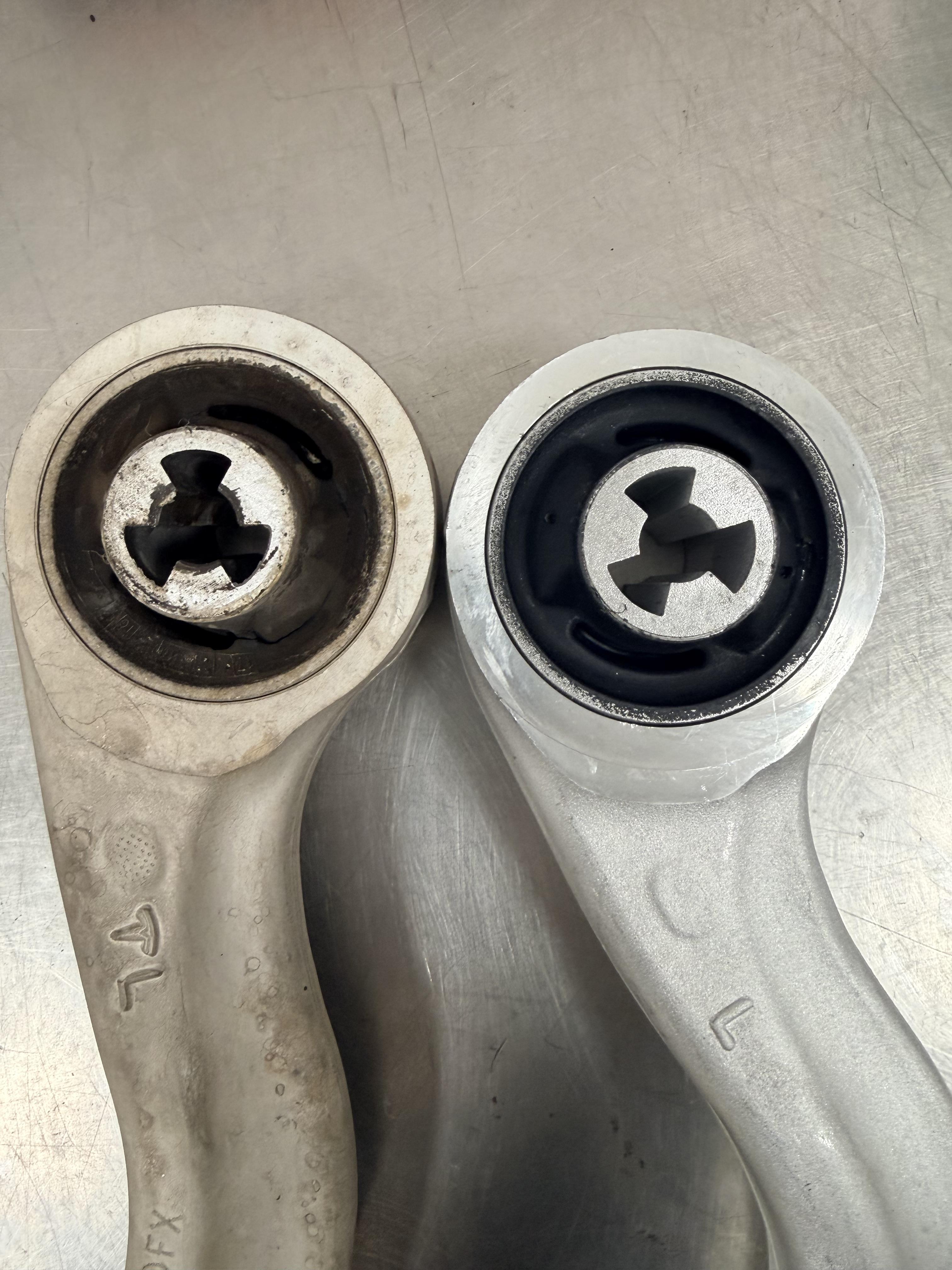
New vs. old control arm bushings
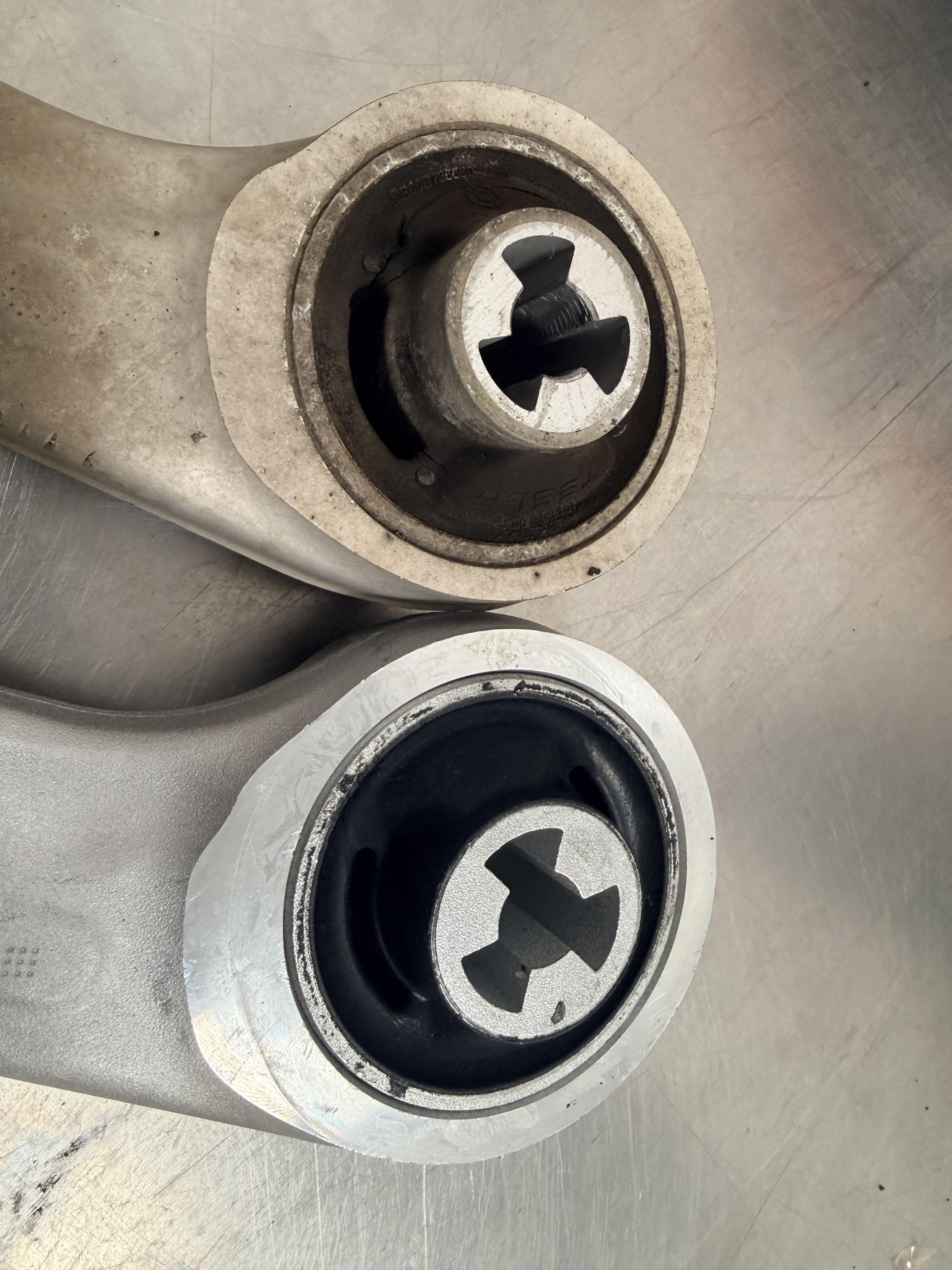
New vs old control arm bushings


This is a real bushing pulled off a car in our shop, not a stock photo. The rubber has torn away from the outer sleeve and split open. You can see daylight through the tear where there should be a solid, bonded ring of rubber. That gap is exactly the play we described above: it’s silent when the rubber is warm enough to flex and fill the space, and it’s a clunk the moment cold weather stiffens what’s left of it.
The takeaway
A clunk that shows up “suddenly” when the weather turns cold almost never started that week. It started months earlier, and the cold just stopped letting the worn rubber hide it. If your Tesla has developed a new creak, clunk, or knock up front now that temperatures have dropped, it’s worth having the front control arms actually inspected (on the lift, by hand) rather than guessing based on when the noise started.
Hearing a new clunk or creak up front? Contact Duro EV and we’ll get it on the lift, show you exactly what’s worn, and walk you through the repair options before we touch anything.